A weekend of innovation, learning, and some of the best hacks yet.
There are two fish in a tank. One turns to the other and says: “So, how do I drive this thing?”
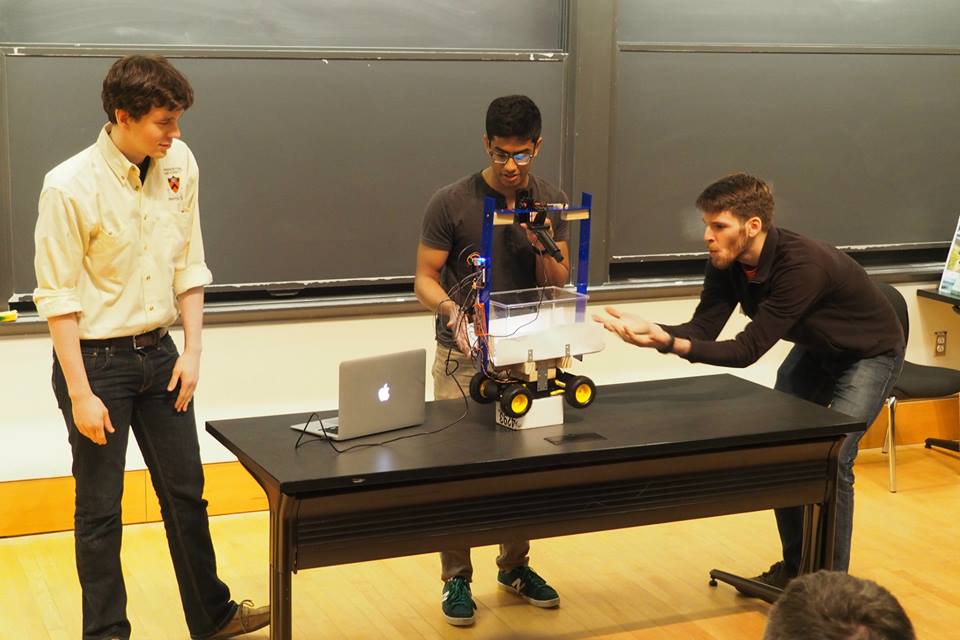
Joseph Bolling ’15 coaxes a fish to swim toward him during team IneFISHency’s demo
We all know that fish can’t really drive tanks, but what if they could? Joseph Bolling ‘15, Ted Brundage GS, and Ankush Gola ’15 of Team IneFISHency, tackled this question at the HackPrinceton event this weekend. Winner of Best Hardware Hack, the team awed the crowd as they presented their fish-controlled vehicle. Using a webcam, computer vision algorithms, and a fish, the team controlled the vehicle’s motion by tracking the swimming patterns of a fish swimming inside its tank. When asked about the inspiration behind their mobile fish tank, Ankush said, “We thought it would be a fun little project combining a lot of different technologies.” Silly and fun in application, yet surprisingly complex to create, IneFISHency embodied the spirit of this semester’s HackPrinceton.
HackPrinceton is a biannual event organized by the Princeton Entrepreneurship Club where over 500 university students from Texas to Ontario come together to learn and create. As HackPrinceton co-director Jerry Liu ‘17 put it, “HackPrinceton is fundamentally a learning experience… Our fundamental mission is for [hackers] to apply [their] engineering skills into a broad range of fields that they might not have explored before.” From the dozens of professional mentors to the piles of the latest gadgets in the electrical engineering lab, this mantra of learning and exploration permeated the weekend-long event.
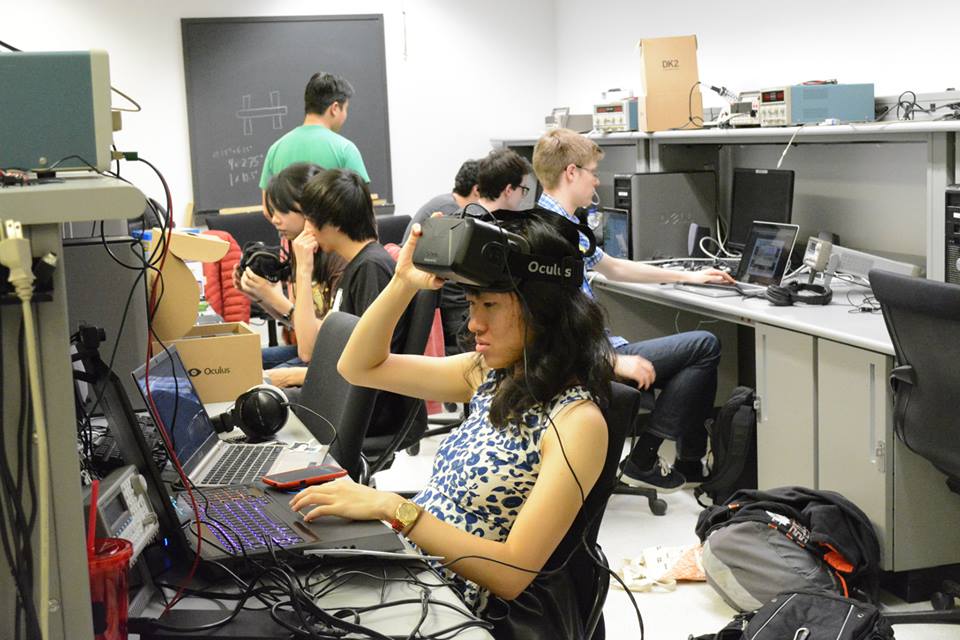
Students are provided with a wide selection of the newest gadgets during HackPrinceton
24 hours of nonstop hacking aside, HackPrinceton also boasted a wide variety of workshops, speakers, and fun events. Former Google CEO and executive chairman Eric Schmidt ’76 kicked off the event speaking on the importance of “permissionless innovation” in advancing technology. This was followed by a series of workshops ranging from how to create a web app to the nitty-gritties of machine learning. In between, the hackers duked it out on the iPhone game Flappy Bird for a five-pound bag of Haribo gummy bears and took aim in an intense round of laser tag. Computer security expert Professor Edward Felton capped off the 24 hours with closing remarks on the recent “Great Cannon” cyberattack.
Even so, the student projects epitomized the spirit of learning and exploration at HackPrinceton. In addition to fish-controlled vehicles, projects ranged from finding parking in New York City to using YouTube as a storage device with unlimited memory. The winner of the Software prize, Andrew Simpson of Western University, used his interests in the virtual reality headset Oculus Rift and the new gesture control device Myo to create a simulator that allows users to freely explore the surface of Mars.
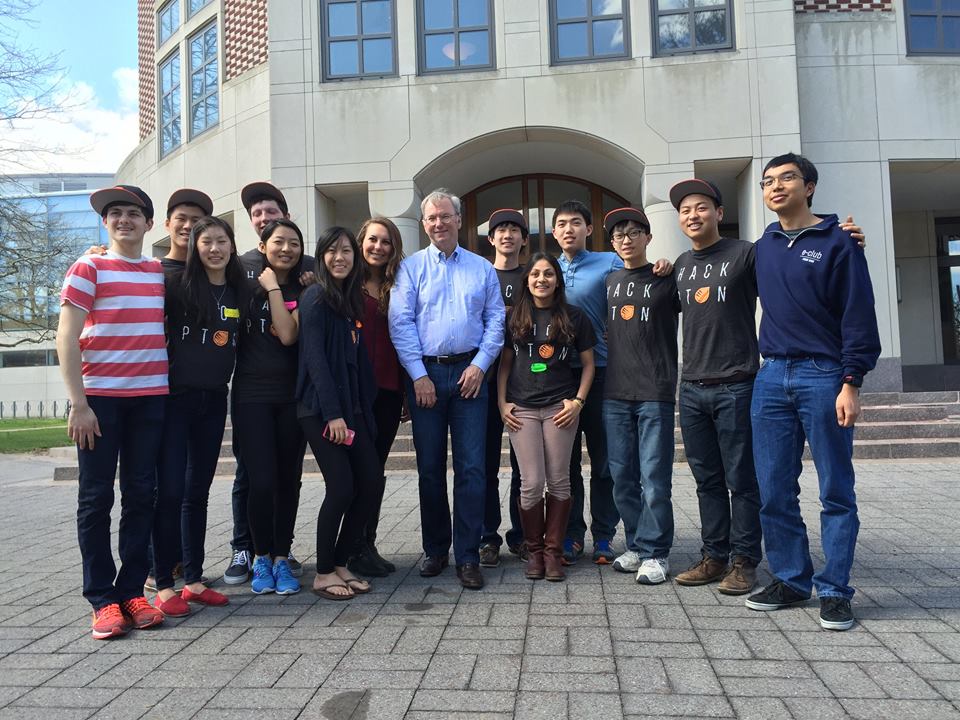
The HackPrinceton organizing team with keynote speaker Eric Schmidt ’76
Through the event, HackPrinceton co-directors Jerry Liu ’17 and Raeva Kumar ’17 have made impressive breakthroughs in hackathon culture. Previously, only 15% of hackathon participants were women. This year, female hackers comprised nearly 40% of participants. In addition to encouraging broader demographic participation, Jerry and Raeva wanted to make the hackathon accessible to people of all skill-levels. “We see HackPrinceton as a microcosm of the tech industry… Like any industry [the tech industry] still has its problems,” Raeva explains. “What we can do with HackPrinceton is try and help mitigate those problems on a smaller scale… The goal is to get everybody building.”
From the smiling faces of the hackers as they showcased their projects to the stacks of Red Bull on the side, it was clear that HackPrinceton was a huge success. By creating an open space for learning and creativity, this year’s HackPrinceton has yet again proven itself to be a weekend of “permissionless innovation.”